


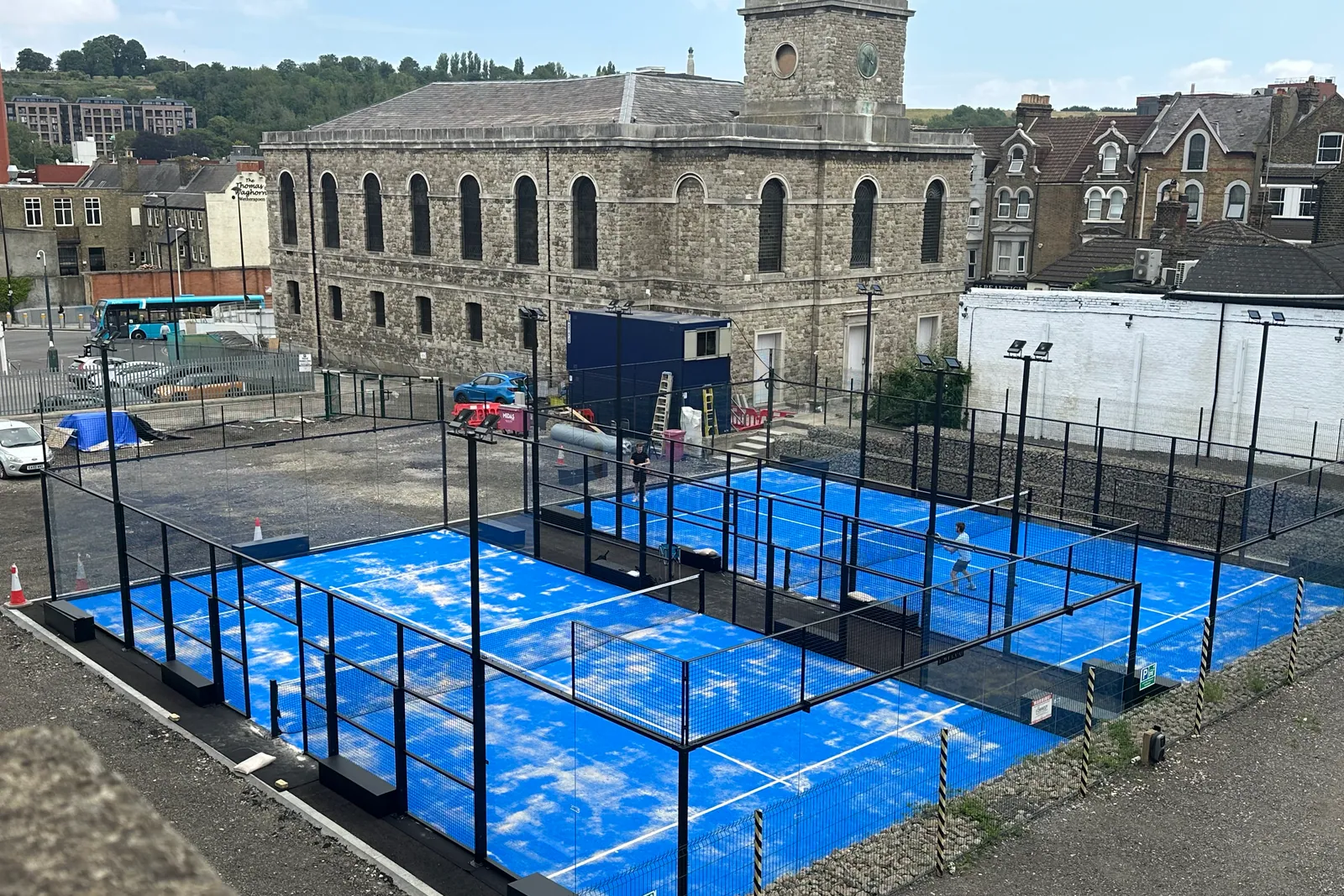
Renting out padel courts revolves around the evening. Between six and ten in the evening you earn the largest part of your revenue, and it is in exactly those hours that the no-shows fall. A group that cancels at quarter to eight costs you not one booking but two: the group that does not come and the group you sent away at seven because the court was full. Anyone who rents out padel courts therefore has two controls that matter more than the price: the length and layout of the time slots, and the rules around not turning up. Below is how you set both, with a table of six measures and what each of them costs you in bookings.
In short
 Choose a slot length that fits a real match, and plan the evening backwards from the last peak booking, so that no lost half-hours arise.
- Paying upfront is the measure that does the most against no-shows; all the other measures only work well on top of it.
- Rebooking instead of cancelling keeps both the revenue and the player.
- A waiting list per time slot turns a late cancellation into a new booking instead of an empty court.
A no-show in padel is a reserved time slot at which the players do not turn up and which was not cancelled in time, so that the court stays empty at a moment when it could have been rented to others. The difference from a cancellation lies in the deadline: anyone who cancels in time gives the court back; anyone who does not come keeps it occupied.
Running padel courts without no-shows: six measures
This table is meant for operators of padel courts who want to choose which measures to introduce, in the knowledge that every measure can also cost bookings. No operator needs all six; three well-chosen measures are usually enough.
| Measure | How it works | Effect on no-shows | Risk to your bookings | Suits |
| Paying upfront | The court is only reserved once it has been paid for | The biggest effect of all six: anyone who has paid either comes or cancels | Players who are used to "we will see", especially at clubs with a till at the bar | Every court, as the first measure |
| Cancellation deadline with rebooking | Free to move up to, for example, 24 hours beforehand; after that the amount is forfeited, but rebooking to an off-peak hour is allowed up to a few hours beforehand | Large, provided the deadline is reasonable and rebooking is easy | Too strict a deadline drives recreational players away; 48 hours is too long for most | Commercial centres with many one-off bookers |
| Reminder on the day itself | A message in the morning with the time, the court and the button to move the booking | Medium: it catches the forgotten bookings, not the unwilling ones | None, provided it is one message and not three | Every court |
| Waiting list per time slot | Anyone who wants a full slot puts himself on the list and gets a message as soon as it becomes free | Changes nothing about the number of no-shows, but gets the empty court rented out after all | Requires that you really keep the waiting list up; a list that nobody calls is worse than no list | Courts with full peak hours |
| Fixed court for regular groups | A regular group rents the same slot every week, paid in advance per month or season | Large for that slot: a regular group rarely cancels and arranges its own replacement | You give away your best hours at a fixed price and can no longer sell them one at a time | Clubs and centres with loyal groups; no more than part of the peak |
| No-show rule after repetition | After failing to turn up twice without cancelling, the player can only book with full payment in advance | Small in number, large as a signal | Requires that you keep track of who did not come, and a conversation at the bar | Centres with a regular core who know each other |
Read the table from right to left: start with what suits your players, and only then look at the effect. A tennis club with a members' evening has different players from a centre next to a business park, and the measure that works at one drives the regular groups away at the other.
Four courts, one evening: 60 or 90 minutes?
The slot length is the first choice, and it determines how much you can sell and how often players stand waiting in the overrun of the previous group. A worked example with assumptions: four courts, a peak evening from 17:00 to 23:00, so six hours per court. The amounts are example figures.
With time slots of 60 minutes you have six slots per court, 24 per evening. Assume a rate of 28 euros per slot: on a full evening that is 672 euros. With time slots of 90 minutes you have four slots per court, 16 per evening. Assume a rate of 38 euros per slot: a full evening brings in 608 euros. On paper the one-hour model wins.
In practice it does not. A padel match between four recreational players rarely lasts a neat hour; most groups want an hour and a half and, with 60-minute slots, book two slots in a row, or are still on court at 19:02 while the next group waits at the gate. A centre that goes from 60 to 90 minutes loses two slots per court per evening and gains calm, satisfied players and an overrun that no longer exists. On top of that, two consecutive hours in a 60-minute schedule often leave half an hour between two groups that nobody books.
The rule that follows from this example: choose the slot length on the basis of how long your players really play, and plan the evening backwards from the last peak slot. If you want your last 90-minute slot to start at 21:00, then your evening starts at 18:00 or at 16:30, not at 17:00. The same principle as choosing a half-day instead of an hour when renting out rooms.
Paying upfront is the measure, the rest is a bonus
Take a padel centre with six courts on the edge of a medium-sized town. Until last season, players could reserve a court and pay at the bar. On Friday evenings two to three slots that had still been full at six o'clock were structurally empty, and every week the manager sent away groups who could have played later. The centre introduced payment upfront, with one exception: members with a fixed court pay per month. Within a month the empty peak slots had virtually disappeared, not because players became more honest, but because cancelling now cost something and rebooking was free.
That last part is what operators forget. Paying upfront without easy rebooking feels like a fine and produces angry messages. Paying upfront with rebooking to an off-peak hour up to a few hours beforehand feels like service. The player keeps his money, you keep your revenue, and the slot on Friday evening goes to the waiting list. How to write down the deadline and the rules properly is covered in the article on cancellation terms.
Outdoor courts: move instead of cancel
With outdoor courts the weather is the biggest source of cancellations, and those are not no-shows but simply sensible. So treat them differently. A shower at seven o'clock does not mean that the slot is forfeited, but that it is moved. Put that word for word in your rules: in the event of rain a group may rebook free of charge right up to the start time, and you decide at four o'clock, on the basis of the forecast, whether the evening goes ahead. A fixed rain rule prevents ten separate discussions a week and prevents players from no longer booking at all, as a precaution, when the forecast is uncertain.
A centre with indoor and outdoor courts can do this even more cleverly: when it rains, the outdoor bookings move to the next free indoor slots, in order of booking. That is work for the manager, but it turns an evening full of cancellations into an evening that still gets paid for.
When strict rules work against you
Not every court benefits from the full set. A club where members know each other and divide the court up through the members' evening gets more from a reminder and a good conversation than from payment in advance; there, paying upfront feels like distrust and costs goodwill that you cannot buy back. A holiday park or hotel with two courts for guests rents out those courts as a service, and a no-show rule after repetition makes no sense there; the guest is gone next week. And a centre that has only just opened first needs bookings before it can protect them: start there with paying upfront and rebooking, and only add the waiting list once the peak is really full.
The line is drawn at the fixed court. It is tempting to give all peak slots to regular groups, because they always come. But that way you give away your best hours at a fixed price and can never again let a new player have a taste on a Friday evening. Keep part of the peak free for one-off bookers; they are next year's regular groups.
How to start this week
- Count, for the past four weeks, how many peak slots stayed empty that had been reserved earlier. That figure is your no-show problem in euros and determines how much effort it is worth.
- Choose your slot length on the basis of how long your players really play, and plan the evening backwards from your last peak slot.
- Introduce payment upfront with free rebooking up to a fixed deadline, and add the rain rule for outdoor courts. From that moment players reserve online in Bookedin's reservation system for padel courts, pay straight away and automatically receive a confirmation with the rules.
- Send one reminder on the day itself with the time, the court and the option to move the booking.
- Keep track for four weeks of which slots become free and who is waiting for them. If it turns out the waiting list is used every week, that is your next measure; if it turns out to be occasional, you do not need it.
Renting out padel courts is not a battle against players who do not come, but a matter of rules that make cancelling easier than staying away. Paying upfront ensures the player has something to lose, rebooking ensures he does not lose it, and the waiting list ensures you never lose it. Anyone who has those three in place no longer has to send groups away on a Friday evening.
Last checked on 8 October 2026.
Frequently asked questions
As long as a real match between your players lasts, and for most recreational players that is closer to an hour and a half than an hour. Slots of 60 minutes give you more slots per evening on paper, but in practice groups book two in a row or run over into the next group. Slots of 90 minutes give fewer slots, less overrun and fewer lost half-hours. Watch for four weeks what time groups actually leave the court and choose on that basis.
Have players pay upfront; that is the measure that does the most. In addition, make rebooking easy and free of charge up to a reasonable deadline, so that cancelling is more attractive than staying away. Send one reminder on the day itself with the option to move the booking. Keep a waiting list for full peak slots, so that a late cancellation still gets rented out. Apply a stricter rule for repeated no-shows only with a regular core of players you know.
Yes, if that is clearly stated in your terms beforehand and the player agreed to it when booking. With payment upfront the question is usually redundant: the amount has already been paid and is forfeited if the player does not turn up, unless he rebooked within the deadline. Put the deadline, the rain rule and what happens in the event of a no-show word for word in your terms and in the confirmation. How to write those terms is covered in the article on cancellation terms.
For one-off bookings, 24 hours is a deadline that most players accept; 48 hours feels too strict to recreational players and costs bookings. More important than the deadline is what is still allowed after it: anyone who cancels after the deadline must still be able to rebook to an off-peak hour, so that he does not lose his money. For outdoor courts there is a rain rule on top of that, which allows rebooking right up to the start time. Choose one deadline for all courts; exceptions per court lead to arguments at the bar.
Anyone who wants a full time slot puts himself on the list for that specific slot. If it becomes free through a cancellation or rebooking, the first person on the list gets a message and a short time to confirm; if he does not respond, it goes to the next. The waiting list does not reduce the number of no-shows, but it means a peak slot that has come free still gets rented out. It only works if you really handle it; a list from which nobody is ever called is worse than no list.
For part of your peak hours, yes. A regular group of four that rents the same slot every week and pays a month in advance almost never cancels and arranges its own replacement. If you give all peak slots to regular groups, a new player can never again try a court on a Friday evening and you sell your best hours at a fixed price. So keep, for example, half of the peak free for one-off bookers, and review the fixed courts each season.
Any other questions? You can always email us at info@bookedin.nl.