


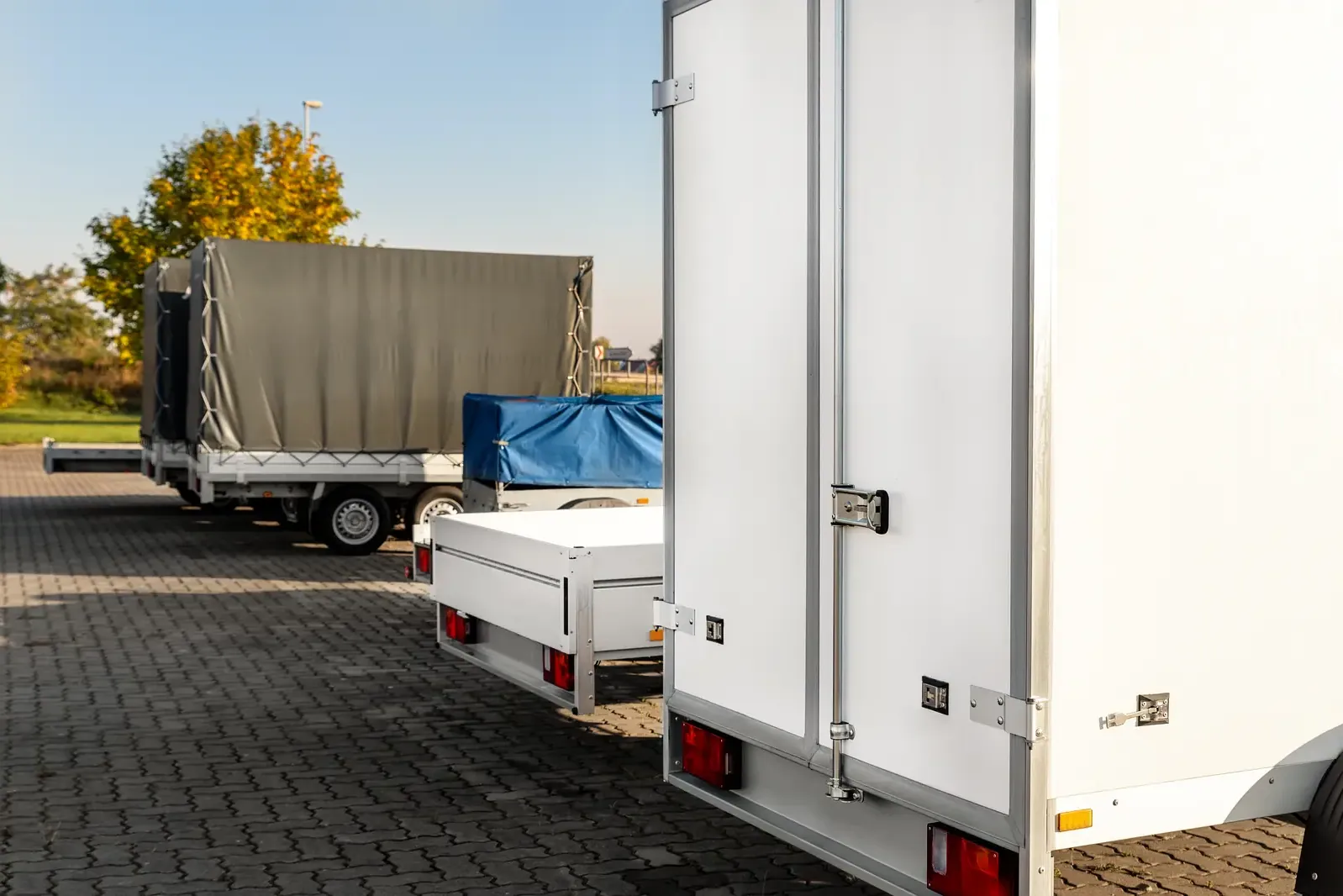
Renting out trailers is a trade of changeovers: short rental periods, many handovers a day, and every handover a chance of a damage dispute. Anyone renting out trailers without a fixed handover and return procedure loses those disputes not because he is wrong, but because he has nothing to show. The answer is not a thick contract but a ten-point card that you go through at every handover and every return, and a one-minute coupling check before the customer drives away. That costs four minutes per changeover and saves you the Saturday afternoon on which you stand bickering with a customer over a side panel.
In short
 Handover and return are the same list, filled in twice: what you record at departure, you compare on return.
- The coupling check (coupling, cable, plug, lights, jockey wheel, tyres, number plate) is done by you, not by the customer. That is where most of the damage and most of the liability arise.
- Four photos at departure and four on return, taken in the same spot, settle almost every dispute.
- Start with one card and one fixed handover spot; change nothing about your prices or your stock until this is running.
Handover and return in trailer rental is the fixed procedure by which a rental business checks and records the condition, the coupling and the paperwork of a trailer at departure, and checks the same points again on return so that damage, missing parts and late returns can be established straight away.
Renting out trailers: the handover and return card
This card is meant for everyone who rents out trailers and wants to standardise the handover, even when it is carried out by a member of staff at the petrol station or the DIY store. Ten points, two columns, one sheet of A4.
| Checkpoint | At handover | At return |
| 1. Customer and driving licence | Check name, licence number and category; it is in the booking | Not needed |
| 2. Towing vehicle | Note the registration number; look at the tow bar and the plug socket | Not needed |
| 3. Four photos | Front left, front right, rear left, rear right, in the fixed handover spot | The same four, in the same spot |
| 4. Side panels, floor, cover | Name dents, tears and bent hinges and put them on the card | Compare with the handover; report any difference straight away |
| 5. Tyres and jockey wheel | Visible damage, pressure by eye, jockey wheel up and secured | The same; watch out for a flat tyre that "was already like that" |
| 6. Lights | Connect the plug, test all the lamps with the customer present | Test before uncoupling |
| 7. Coupling and cable | Coupling locked, breakaway cable or secondary coupling around the tow bar | Coupling and cable back complete |
| 8. Accessories | Ratchet straps, net, loading ramps, key for the lock: note the number | Count the number, charge for anything missing straight away |
| 9. Number plate | Up to 750 kilos: plate of the towing car fitted; heavier: own registration number present | Plate removed or registration number present |
| 10. Time and signature | Departure time and agreed return time; the customer signs the card | Note the return time; the rental business signs off |
The strength lies not in the ten points themselves but in the repetition. Anyone who picks up the same list at return as at handover never again has to ask whether a scratch was already there. He looks at the card.
You do the coupling check yourself
Most customers couple a trailer twice a year. You do it twenty times a day. So never leave the coupling to the customer, however confident he sounds. A trailer that comes loose on the motorway is not only his problem.
The coupling check in one minute, in a fixed order: coupling on the tow ball and locked, pull on the handle to feel it; breakaway cable or secondary coupling around the tow bar, not around the ball; jockey wheel wound up and secured; plug in the car, with an adapter if it is 7-pin to 13-pin; test the rear lights, brake lights and indicators while the customer sits in the car; one walk round to look at the tyres and the number plate; and last of all the load, if it is going on at this point, with ratchet straps and not with a piece of rope the customer still had lying in the boot.
Take a petrol station with twelve trailers along a provincial road. Saturday morning, half past eight: the first customer is standing there with an estate car and a 13-pin socket in front of a trailer with a 7-pin plug. Without an adapter in the cupboard that means one rental fewer and a customer who drives to the competitor. With an adapter on a little chain by the till it is thirty seconds of work. That same petrol station keeps track of which plug each trailer has and puts it on the booking confirmation, so the customer knows what to expect.
Photos in a fixed spot
Four photos per handover are enough, on condition that they are always taken in the same spot: the same parking bays, the same angle, the same light. A photo of a trailer that stands against a white wall at departure and in the half-dark next to a skip on return is worth nothing in a dispute. So mark one handover bay with paint or a sign and take all your photos there.
How such a dispute then goes: on Sunday afternoon a customer brings back a box trailer with a tear in the cover. He says it was already there. The member of staff picks up the card from Saturday morning: point 4 says "no damage", and the rear right photo shows an intact cover. The conversation takes a minute and the deposit is settled as the terms say. How to do that settling properly without it escalating is worked out under deposits and damage in equipment rental. Anyone who wants to do the handover entirely without staff can extend the photo protocol to the version from the article on unstaffed car rental, but with trailers the coupling check remains the argument for being there yourself.
Driving licence, weight and number plate
In the Netherlands, three rules determine who may tow what, and your customer rarely knows them. A trailer of up to 750 kilos may be towed with an ordinary category B licence behind almost any car, and uses the number plate of the towing car. Above 750 kilos there are limits on the total weight of the combination, for which a category B licence with code 96 or a BE licence may be required, and the trailer has its own registration number. The exact limits are on government.nl and with the RDW, the Netherlands Vehicle Authority; you check them once and put them on your card.
In practice this means you ask for the licence category at the time of booking, not at the counter. A customer who books a car transporter with only a B licence and a small car should hear that when booking, not on Saturday morning with his brother-in-law's car at the door. So also ask for the registration number of the towing car in the form; that lets you check in advance whether the combination is possible.
When you need to do it differently
A fixed card works for the bulk of rentals, but not everywhere.
With horse trailers and car transporters the card is the minimum and a briefing comes on top: how to load, how to secure, where the centre of gravity belongs. That takes a quarter of an hour, and you put that quarter of an hour in your price. With multi-day rental to a sole trader who comes every week, you can skip the photos at handover if you keep the return strict; the card stays, the photos do not. And on a busy Saturday with one member of staff, the temptation to skip the lighting test is great. Do not do it. A trailer without working brake lights that comes off your premises is the one point on the card where you, as the rental business, are the one in trouble if things go wrong.
How to start this week
- Print the ten-point card on A4, make a pile of them and put it at the handover spot. Not digital, not in an app; on paper first, so that everybody uses it.
- Mark one handover bay and from now on take all your photos there, at departure and on return.
- Hang a 7-to-13-pin adapter and a 13-to-7-pin adapter on a little chain by the till, and record the plug for each trailer in your overview.
- Set fixed collection and return times and ask in your booking form for the licence category and the registration number of the towing car, so that you can see it in advance. In Bookedin's reservation system for trailer rental you set those times and add those fields to the booking form yourself.
- Do the coupling check at every handover for two weeks, including for regular customers, and note what you come across. You will be surprised how often the cable is around the ball.
Renting out trailers does not get easier with a better contract but with a fixed handover that always goes the same way. Ten points, four photos and one minute at the tow bar: that is all there is to it. Anyone who keeps that up no longer has damage disputes, only damage handling. And that is exactly the difference between a rental business that earns money on Saturday and one that argues on Saturday.
Last checked on 8 October 2026. This article is not legal advice.
Frequently asked questions
In the Netherlands, an ordinary category B licence is enough for a trailer of up to 750 kilos, behind almost any car. Above 750 kilos it depends on the combined total weight of car and trailer: up to a certain limit a B licence is still allowed, above that a category B licence with code 96 or a BE licence is required. The exact limits are on government.nl. So ask for the category at the time of booking and put on your card which licence goes with which trailer, so that a member of staff does not have to do it from memory.
No, not always. Under Dutch rules, a trailer of up to 750 kilos runs with a white number plate carrying the registration number of the towing car. As a rental business you therefore keep a stock of blank plates, or you agree with the customer that he has one made himself. Trailers above 750 kilos have their own registration number in your name, and as the registered keeper you are then the point of contact for fines and registration. Check the current rules with the RDW, the Netherlands Vehicle Authority.
Record at handover what you are going to compare at return: four photos in a fixed spot, a card with ten checkpoints and a signature from the customer. Almost every dispute arises because the rental business recorded nothing at departure and sees something on return. With the card and the photos there is no longer a dispute, only a comparison. Name existing damage explicitly on the card, then nobody can attribute it to the customer later.
That depends on the current value of the trailer and on the excess of your insurance, not on a fixed amount that everybody uses. An open trailer worth a few hundred euros calls for a different deposit from a car transporter. Tie the deposit to what an average claim costs you, put the amount and the refund period in your terms, and collect it in advance. How you set the amount and how you withhold without a row is covered in the article on deposits and damage in equipment rental.
Couple it yourself, always. The coupling check is part of the handover, not a service. If the plug does not fit, you have an adapter from 7 to 13 pins and the other way round to hand. If there is no tow bar or a detachable tow ball has been fitted incorrectly, the trailer does not go, however annoying that is. A customer who drives off your premises with a loose cable or without working lights is a risk you do not want to carry as a rental business.
Yes, but with trailers that is less sensible than with a car. The coupling, the cable and the lights are exactly the points where things go wrong with inexperienced customers, and you would rather check those yourself. If you still want to rent out unstaffed, for example outside opening hours, do it only with unbraked trailers of up to 750 kilos, an extensive photo protocol and a customer you already know. The approach from the article on car rental without a counter is the starting point for that.
Any other questions? You can always email us at info@bookedin.nl.